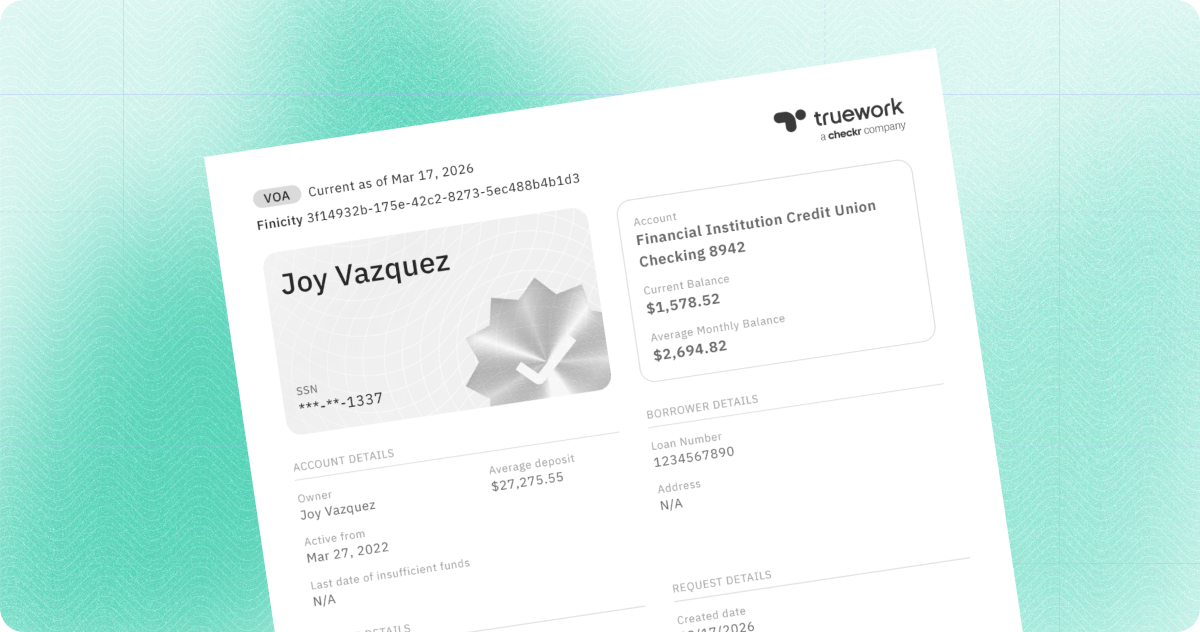
Why Coverage Rate isn’t the Primary Success Metric for Income Verification
Coverage rate is one of the most commonly cited metrics in income verification, but it may be costing mortgage lenders more than they realize.
Organizations still evaluate and measure the success of their VOI/VOE providers by how much coverage they can provide. As in, how many people a provider can verify.
At the surface, coverage rate makes sense: It’s important that an income and employment verification provider has access to the broadest range of the U.S. population, covering all types of earners and income types. Theoretically, a higher coverage rate equals a higher success rate. But coverage rate isn’t the be-all and end-all of income verification metrics.
What is coverage rate and why is it a misleading income verification metric?
Coverage rate: The breadth of an income verification provider's reach, often expressed as the percentage of the U.S. population for which it can provide a verification report or as an absolute number of employee records.
The problem with coverage rate is that it’s a vanity metric focused on quantity, not quality. Income providers can say they have data on a majority of people, but how good is that data? Is it recent and accurate? Will it actually give you a quick and successful verification? Coverage rate can’t tell you that.
What happens more often than not is organizations using vendors who promise high coverage rate (and nothing else) end up paying more on their verifications. When you get back bad data, you have to keep hunting for the actually usable information you need. Re-rerunning verifications gets costly fast, not to mention, slows down the loan closing process which directly impacts mortgage income verification costs.
What is Completion Rate?
Completion rate is a success-based metric that measures the effectiveness of an income verification provider in generating complete and usable reports. It’s not theoretical like coverage rate; it’s an actual measurement.
Completion rate is the average percentage of income verification requests that result in a full verification report. A full report is defined as a report with vetted, accurate information that is immediately usable to a lender.
When evaluating an income verification platform, it is crucial to prioritize completion rate over coverage rate. A high completion rate signifies that the provider is successful in obtaining the necessary information and generating reports efficiently.
Completion rate provides the accuracy and reliability that teams need to close loans quickly without duplicative efforts.
How does this help in lowering costs?
Vendors that prioritize completion rate often don’t charge for unsuccessful attempts; which means you only pay for completed reports. You stop paying for multiple verification requests. Your teams process loans more quickly and with increased confidence. This boost in efficiency ultimately lowers overall mortgage income verification costs.
How should mortgage lenders evaluate income verification providers?
As loan origination costs increase and mortgage rates remain volatile, mortgage lenders have the opportunity to create more stability by anchoring to income verification metrics that tell the full story.
Evaluate your VOI/VOE providers, look at how they measure success, and align to businesses that know what it takes for you to win.